Leaks, storm damage, open seams, failed flashings at curbs and parapets, blocked drains and damaged edge metal. We find where the water enters, not just where it shows up inside, and repair the detail that failed. Where the insulation under the membrane is wet, we tell you in writing, because a patch over wet insulation does not last.
Commercial roofing · Miami-Dade
Miami commercial roofing contractor
Perkins Roofing Corp. is a commercial roofing contractor in Miami. We repair, re-roof, coat and maintain low-slope and high-rise roofs on condominiums, offices, retail buildings and warehouses across Miami-Dade County. The company was founded in 1980, holds Florida Certified Roofing Contractor license CCC1331944, and runs its Miami-Dade work from the Miami office at 575 NW 152nd St (305-642-7663).
- Founded
- 1980
- Counties served
- 6
- Florida offices
- 2
Commercial roofing · Miami
Commercial roofs in Miami: repair, restore or replace
Many commercial roofs in Miami are flat or low-slope, and all of them sit in the High Velocity Hurricane Zone. Sun, salt air, summer storms and rooftop equipment wear them out. The work usually starts with a question: can this roof be repaired or restored, or has it reached the point where it needs to come off? We answer that from a documented inspection, then write a scope your board, property manager or owner can compare against other bids.
Commercial roofing covers a lot of ground. A strip-mall owner with a leak over one tenant, a condominium board planning a re-roof around its reserve study, and a warehouse manager with ponding water across a large roof all need different scopes. The sections below cover the services we provide in Miami, the roof systems we work with, the code and permit rules that apply here, and the Miami-Dade projects we have documented.
Services
Commercial roofing services in Miami
Tear-off to the deck, deck repairs, insulation (tapered where the roof needs slope to drain), membrane, flashings and closeout under a building permit and inspections. On occupied buildings we phase the work so no section is left open overnight and tenants keep their access.
Scheduled visits that clear drains and scuppers, check seams, flashings, curbs and sealants, and document what changed since the last visit, with small repairs made before they become leaks. A maintenance record also gives a board or owner the history it needs when planning the next roof.
Silicone, acrylic and polyurethane fluid-applied systems can extend a serviceable low-slope roof when the substrate is dry, the details can be reworked and the roof drains. Our Miami Beach condominium project below is an example. Over trapped moisture or a failed membrane, a coating is the wrong answer.
Condition inspections for owners, managers and boards, with photographs and a written summary of the field, perimeter, penetrations and drainage. They are useful before a purchase, before a budget cycle or after a storm.
Roofs on occupied towers, including rooftop mechanical enclosures, where hoisting, staging, resident notices and work at height shape the plan as much as the roof system does.
Roof systems
Commercial roof systems we install and repair
System
Heat-welded white sheets over insulation, widely used on low-slope commercial roofs. The welded laps are only as good as the crew making them.
System
Multi-ply asphalt membrane systems, reinforced and surfaced for UV. They hold up well to foot traffic around equipment.
System
Layered felts and bitumen, common on older Miami buildings. Many existing roofs are built-up systems, so knowing how to repair and tie into them matters.
System
Standing-seam and other panel systems where the slope allows, with fasteners and trim chosen for coastal exposure.
System
Silicone handles ponding better than acrylic. Acrylic is economical on roofs that drain well. Polyurethane is the toughest of the three for foot traffic. All three need a sound, dry substrate.
Code and permits
HVHZ, the Florida Building Code and product approvals in Miami
Miami-Dade and Broward are the two counties in the High Velocity Hurricane Zone defined by the Florida Building Code. In the HVHZ, roofing products carry a Miami-Dade Notice of Acceptance (NOA), and the building department reviews the roof assembly, including how the insulation and membrane are attached at the field, perimeter and corners. The roof is permitted and inspected as a specific approved assembly, so a substitute product is not a small change. It has to be approved as well. Search the NOA for any product on a proposal in Miami-Dade’s product approval database.
The permit comes from the building department for the property’s municipality (the City of Miami, Miami Beach, Coral Gables and so on), or from Miami-Dade County for unincorporated areas. Perkins prepares and pulls the permit for every roof we install. Whether a partial repair forces a full replacement depends on the roof’s permit history under the Florida Building Code’s 25 percent rule and the 2007-code exception in section 553.844(5), Florida Statutes. Commercial roof repair vs. replacement walks through it.
Older buildings also have the county’s recertification program (Section 8-11(f) of the county code). Once the county sends its notice, the owner has 90 days to file an engineer’s or architect’s report, and roof leaks and deteriorated roof decks are among the conditions the county tells inspectors to look for. Our recertification and milestone guide covers the deadlines.
Documented projects
Perkins commercial roofs near Miami
These are written case studies from Perkins project records in Miami-Dade, each with photographs from the job. They show restoration, coating and re-roofing on occupied condominium buildings along the coast.
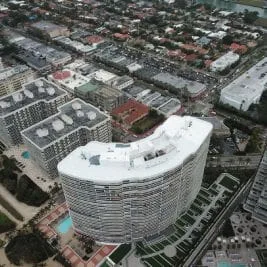
Bal Harbour · Restoration
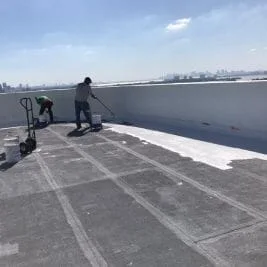
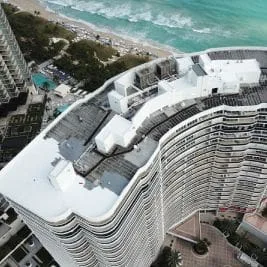
Majestic Towers roof restoration
Staged restoration on an occupied 22-story oceanfront tower.
View project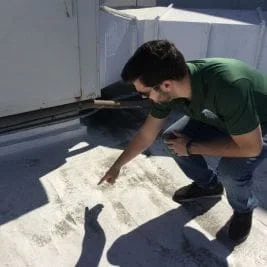
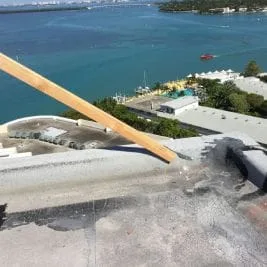
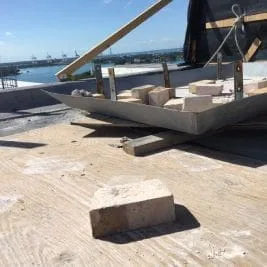
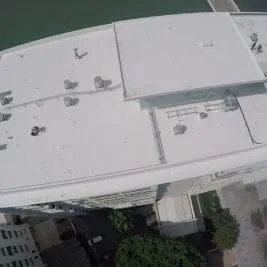
Miami Beach · Silicone coating
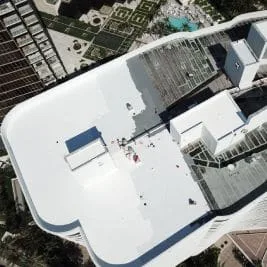
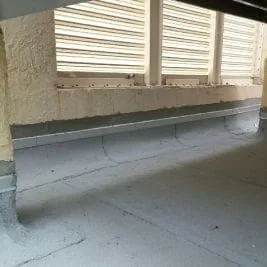
Miami Beach silicone roof coating
A silicone coating system that extended an existing low-slope roof.
View project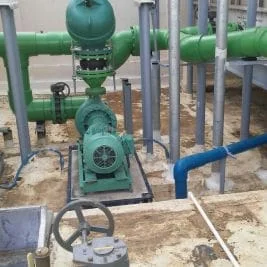
Sunny Isles Beach · Re-roof
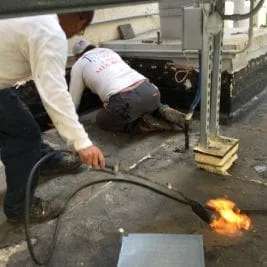
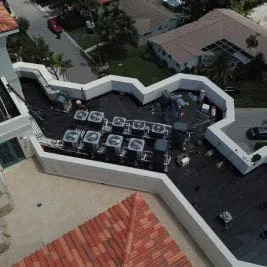
Sunny Isles Beach A/C towers re-roof
Rooftop A/C tower structures re-roofed at Pinnacle Condominium.
View project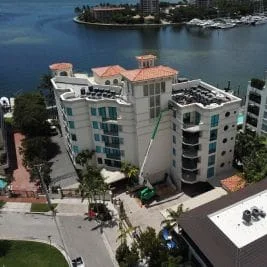
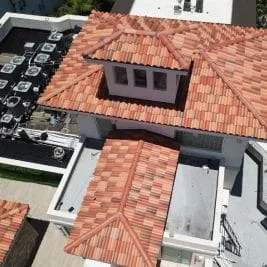
Coconut Grove, Miami · Re-roof
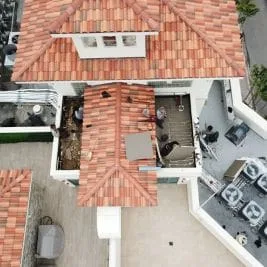
Coconut Grove condo re-roof
A five-story waterfront condominium re-roofed on Biscayne Bay.
View projectPhotographs from Perkins project records. Buildings are named only where Perkins published them itself. All projects and case studies.
How it works
How a commercial roofing project runs in Miami
It starts on the roof. We look at the field, perimeter, penetrations, drains and equipment curbs, go through your leak history, and check the insulation for moisture where the roof’s condition calls for it. You get a written recommendation to repair, restore or replace, and the reasons behind it. A free estimate follows.
For a re-roof, the proposal names the complete assembly: membrane, insulation, cover board, attachment, flashings, edge metal and drains, with the product approvals behind them. It also covers deck-repair allowances, exclusions and the phasing plan for an occupied building. Every bidder should price the same assembly. If they don’t, the totals can’t be compared.
During the work, sections are torn off only as fast as they can be dried in the same day, rooftop equipment is protected or coordinated with your mechanical contractor, and the building department inspects at the stages the permit requires. At closeout you should receive the permit record, the product list and maintenance instructions. That paperwork is the start of the roof’s maintenance history.
Compare the scope
Make competing roof proposals comparable
Give each contractor the same building information, then ask for written answers to these four questions. A lower total can reflect a different scope.
- What stays, and what comes off?
- Identify existing layers, proposed removal, deck investigation and the process for pricing concealed damage.
- Which complete assembly is proposed?
- Compare insulation, membrane or covering, attachment, perimeter details, drainage and rooftop penetrations—not just the product name.
- How will the occupied building operate?
- Document staging, access, equipment coordination, weather protection and communication with tenants or the association.
- What closes the job?
- Clarify permit responsibility, required inspections, closeout documents, written warranty terms and maintenance responsibilities.
Bring the proposals to a commercial roofing scope discussion. Product suitability, price and schedule are confirmed for the actual building.
Choosing a contractor
Hiring a commercial roofer in Miami: the checks that matter
The most expensive mistake in commercial roofing is not vetting the contractor. Owners in a hurry, tempted by a low bid or reassured by a polished website skip the checks, then pay for leaks, downtime and a second roof. This used to be a longer article. These are the checks that matter.
- Look up the license yourself
- Florida roofing contractors must hold a state license. Search the number in the DBPR license lookup and check that the name matches the company on the contract. Perkins Roofing holds license CCC1331944.
- Get the insurance certificates
- Ask for proof of general liability and workers’ compensation coverage. An uninsured crew on your roof can make an accident your liability.
- Ask for commercial work you can check
- Get addresses or case studies of comparable commercial roofs, and references you can call. Residential experience does not transfer to a four-story condominium or a warehouse roof.
- Insist on an itemized, written scope
- The proposal should list the assembly, the details, deck allowances, exclusions and the schedule. A bid far below the others usually leaves something out.
- Read the reviews, then the warranty terms
- Recent reviews on Google and elsewhere show how a company handles problems. Get any manufacturer and workmanship warranty terms in writing before you sign, and read what they exclude.
The original article, “Commercial Roofing in Miami: Common Mistakes When Hiring a Roofer” (December 2024), is archived on Perkins Updates. Read the original.
Talk to the office
Call about a Miami commercial roof
Send the property address, the building type and what you are seeing (a leak, a coating question, a re-roof budget) and we will set up a commercial roof assessment. The Miami office is at 575 NW 152nd St, Miami, FL 33169.
Related: commercial roofing across South Florida, Roofing company in Miami, the annual commercial roof maintenance walkthrough and commercial roof repair vs. replacement.
Questions
Commercial roofing in Miami: questions
What commercial roofing work does Perkins Roofing do in Miami?
Commercial roof repair, re-roofing and replacement, roof maintenance programs, silicone, acrylic and polyurethane coatings, and condition inspections, on condominiums, offices, retail buildings and warehouses across Miami-Dade County, from the Miami office (305-642-7663).
Which roof systems does Perkins install on Miami commercial buildings?
TPO single-ply membranes, modified bitumen, built-up roofing, metal roofing and fluid-applied coating systems. The existing deck, slope, drainage, rooftop equipment and the approved HVHZ assembly decide which one fits a given building.
Does a commercial roof in Miami need Miami-Dade product approval?
Yes. Miami-Dade is in the High Velocity Hurricane Zone, so roofing products need a Miami-Dade Notice of Acceptance and the roof is permitted as an approved assembly. The building department inspects the installation at the stages the permit requires.
Can our Miami commercial roof be coated instead of torn off?
Sometimes. A coating can extend a low-slope roof whose insulation is dry, whose membrane is still continuous and whose details can be reworked. Over trapped moisture, a failed membrane or persistent ponding, it only delays a replacement. An inspection with moisture checks decides it.
How does Miami-Dade building recertification involve the roof?
Recertification under Section 8-11(f) of the county code is an engineer’s or architect’s inspection filed within 90 days of the county’s notice. The county’s guidelines tell the inspector to look at roof deflection, flashings, membrane condition and roof decks, so known roof problems are best repaired and documented before the inspection.
Which Perkins office handles commercial roofing in Miami?
The Miami office at 575 NW 152nd St, Miami, FL 33169 (305-642-7663), which covers Miami-Dade, Broward and Monroe counties. Perkins Roofing Corp. has been in business since 1980 and holds Florida license CCC1331944.
Free estimate
Get a written scope for your Miami commercial roof.
Inspection first, then a recommendation to repair, restore or replace, and a free estimate for that scope.