
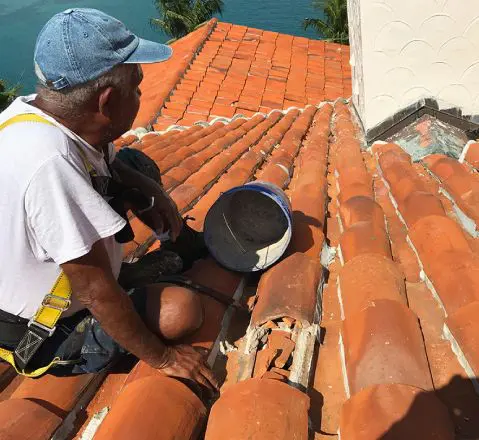
Deck & structural support
Review the existing deck, damaged areas, attachment and the structure supporting the proposed covering. The project documents determine repairs and fastening.
Perkins Roofing · South Florida
Concrete and clay barrel tile roofing.
Keep the architectural character you love—and understand the roof supporting it. We help South Florida owners discuss tile replacement, repairs and the waterproofing details that deserve as much attention as the profile.
Discuss your tile roof Explore the roof system
TILE / THE DETAILS MATTER1980Perkins Roofing founded
6 countiesSouth Florida service area
Miami + JupiterTwo offices to start the conversation
Explore Perkins projects ↗Four decisions behind the finish
A covering is part of an assembly. Explore the questions that turn a material preference into a more complete project conversation.
01 / Structure & profile
Concrete and clay bring different profiles, weights and finishes. A change from shingle or metal to tile starts with the structure and any design review the project needs.
02 / Water protection
Tile sheds rain. Underlayment and flashing manage water that reaches beneath the covering, especially around valleys, walls and penetrations.
03 / Tile attachment
The attachment method belongs to a tested system. Roof geometry, exposure and local requirements determine the design; the tile profile alone does not establish wind performance.
04 / Repair or replace
Sound-looking tile can cover aged underlayment. A useful assessment considers both the visible damage and the condition of the roof beneath it before recommending repair or replacement.
Material & assembly guide
Six parts of the conversation, from structure to attic conditions. This explains their roles; exact products, dimensions and installation are defined in the project documents.
Review the existing deck, damaged areas, attachment and the structure supporting the proposed covering. The project documents determine repairs and fastening.
Identify the approved approach to deck seams and water resistance. Some systems combine functions; these are not necessarily six separate installed layers.
Specify an underlayment approved for the tile system and exposure. Its condition can drive repair or replacement even when the tile remains serviceable.
Coordinate valleys, wall transitions, penetrations and eave details so water has a continuous path off the roof.
The visible covering gives the roof its profile. Tile, attachment and accessories are selected together for the documented assembly.
Review moisture, insulation and the existing attic design. Ventilation details must suit the assembly; a sealed attic requires a different approach.
Coastal behavior
Heat, salt exposure, wind and rain affect different parts of the roof. Discuss the conditions at your address.
Clay and concrete provide a durable exposed surface. Evaluate the full assembly, attic and insulation when considering heat; appearance alone does not predict cooling savings.
Pay attention to valley metal, flashing, drip edge and fasteners. Their material and compatibility matter on coastal properties even when the tile looks sound.
Tile attachment must match the approved assembly and the design for the roof. Perimeters, corners, hips and ridges need deliberate detailing.
Water can pass below individual tiles. Underlayment, flashing and the eave discharge path are essential parts of the weather protection.
An informed next step
A material choice should support the building, your priorities and the actual findings. Bring the address, leak history, existing reports and any association requirements.
Request a roof conversationBroken tiles or a specific flashing defect may be repairable when surrounding materials remain serviceable. A repair recommendation depends on access, matching products and what the inspection finds.
Recurring leaks, widespread underlayment deterioration or deck damage can change the scope. Tile reuse is a project-specific decision, not an assumed saving.
Practical answers
Material fit, maintenance, local requirements and the details worth asking about.
Explore the roof advice library ↗Tile can remain serviceable for decades, but the covering and the roof system do not have the same lifespan. Underlayment, flashing, installation, exposure and maintenance all matter. An inspection is more useful than a fixed age estimate; no lifespan or warranty is established by this guide.
A broken tile does not prove there is an interior leak. It can expose the layers below to weather and damage, so arrange an assessment even if the ceiling is dry. The condition of the underlayment and flashing matters.
Tile is generally heavier than asphalt shingle or metal. A change of covering may require structural review. Confirm the existing structure and proposed system before treating tile as a suitable replacement.
Compare profile, color, weight, available products and the installed scope. Clay offers fired finishes and traditional barrel profiles; concrete offers a broad range of profiles. Exact cost, color retention and performance depend on the selected product and assembly.
No. Miami-Dade and Broward are in the High Velocity Hurricane Zone. The applicable code, local review, product approval and installation instructions control the permitted system. Confirm the attachment and underlayment for the project address.
The specified underlayment must meet the requirements for the roofing assembly and jurisdiction. Ask for the applicable Florida Product Approval or Miami-Dade Notice of Acceptance and verify the exact product, limitations and current status.
Broken or slipped tiles, damaged flashing, repeated leaks and staining can justify an assessment. A sound-looking covering can hide underlayment problems. Observe safely from the ground; do not walk the tile to diagnose it.
Cleaning must follow the tile manufacturer’s guidance. Foot traffic and unsuitable cleaning methods can damage tile or force water where it should not go. Discuss a suitable method and qualified access before scheduling cleaning.
My Safe Florida Home offers inspections and grants for eligible wind-mitigation improvements. Eligibility, funding and application steps can change. Check the official program before committing to work; a roof proposal does not establish grant approval or reimbursement.
Confirm the current requirements for your address and the exact proposed assembly. These references support the questions above; they do not approve a specific roof.
Your next roof starts here
Speak with Miami or Jupiter about your tile roof, priorities and next steps.
Discuss your tile roofScope, products, price, availability and applicable warranties are confirmed for your project.
Miami office
305-642-7663 — call the Miami officeMonroe · Miami-Dade · Broward
Jupiter office
561-559-7663 — call the Jupiter officePalm Beach · Martin · St. Lucie