Get a Free Instant Roof Estimate

Roof Now, Pay Later

Commercial Roofing Miami – How to Choose a Commercial Roofing Provider for Large Buildings

Choosing a commercial roofing provider in Miami is a major property decision. A roof failure can interrupt tenants, damage inventory and equipment, create safety concerns and expose the owner to repeated emergency costs. For condominiums, multifamily buildings, hotels, retail centers, offices and industrial facilities, the contractor must be able to manage more than the roof surface.

The right provider should understand Miami-Dade’s High-Velocity Hurricane Zone (HVHZ) requirements, commercial permitting, approved roof assemblies, drainage, occupied-building logistics, storm preparation and long-term maintenance. Perkins Roofing Corp. has served South Florida since 1980 and works with property owners and managers across Miami-Dade.

Start With the Building, Not a Preferred Roofing Product

A responsible commercial roofer should first assess the building, existing roof, deck, drainage and exposure. The same material or assembly is not appropriate for every property.
  • What roof system is currently installed?

  • Is the deck sound and dry?

  • Where does water collect or drain slowly?

  • Are leaks isolated or spread across several roof areas?

  • How much rooftop equipment and service traffic is present?

  • Will tenants or operations remain in place during the work?

  • What product approval and attachment method will apply?

Commercial Roofing

Perkins Roofing evaluates modified bitumen, fluid-applied restoration systems, metal roofing and other approved options based on the building. TPO may be considered for selected projects but is not normally the company’s primary commercial system. Perkins Roofing does not offer EPDM roofing.

Confirm Miami-Dade HVHZ and Product-Approval Experience

Commercial roofing in Miami must comply with the Florida Building Code and the additional High-Velocity Hurricane Zone requirements that apply in Miami-Dade. The product approval and installation details must suit the building’s deck, roof configuration, attachment method and required design pressures.

Ask the contractor to identify the proposed assembly, applicable Notice of Acceptance or other accepted product approval, permitting responsibility and any project-specific engineering. A general reference to a ‘hurricane-rated roof’ does not provide enough information to confirm that the complete assembly is appropriate for the building.

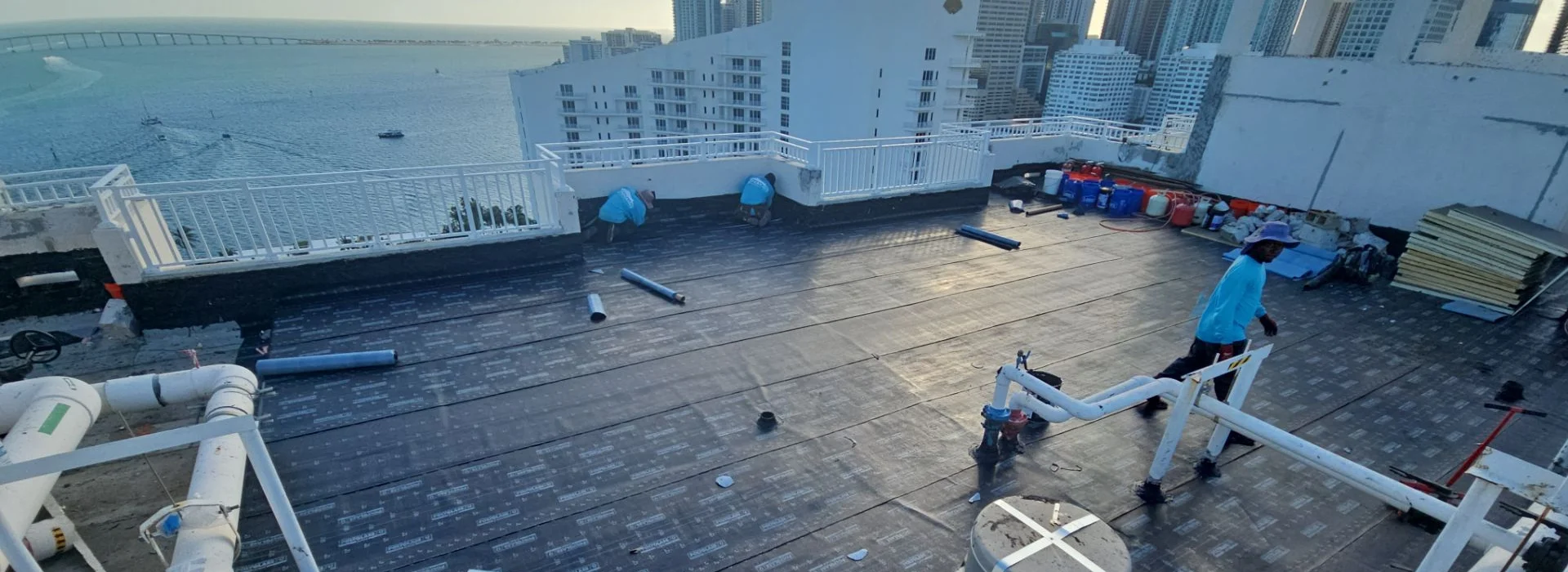
Aerial view of a commercial roof on a waterfront property in Miami-Dade
Jupiter Condo Roofing Project

Review the Contractor’s Commercial Project Experience

Large and occupied properties require planning for access, safety, noise, debris, weather, material staging and communication. A contractor that primarily handles small residential projects may not have the systems required for a condominium, high-rise, retail property or multifamily community.

Perkins Roofing’s Miami-Dade project portfolio includes condominium and villa roofing projects in Miami Beach, Coconut Grove, Fisher Island and Bal Harbour. These projects demonstrate experience with high-value properties, occupied environments and South Florida roofing systems.

Understand Repair, Restoration and Replacement

Not every commercial roof problem requires full replacement. A focused repair may be appropriate when the roof remains serviceable and the source of water entry can be isolated. A compatible fluid-applied restoration system may be considered where the existing roof is suitable and a seamless protective surface can improve waterproofing and extend its service life.

Replacement becomes more likely when moisture is widespread, repairs are repetitive, drainage or deck conditions are failing, or the current system can no longer support the building’s future requirements. The proposal should explain why the recommended option is appropriate rather than simply presenting the highest-value scope.

Commercial Roofing Miami - How to Choose a Commercial Roofing Provider for Large Buildings - commercial roofing in miami
Commercial Roof Inspection Checklist

Ask How the Roof Will Be Inspected and Maintained

A commercial roof should be managed as a building asset. Scheduled condition inspections can identify failed sealant, damaged flashing, blocked drains, coating wear, open seams and damage caused by rooftop service traffic.

For Miami property managers, inspections are particularly useful before hurricane season, after significant storms, after work by other rooftop contractors and before warranty deadlines. Formal wind mitigation and four-point insurance inspections are different from roof-condition inspections and must be completed by an appropriately qualified inspector. Perkins Roofing may arrange a qualified third party when one of these prescribed insurance inspections is required.

Check Licensing, Insurance, Safety and Documentation
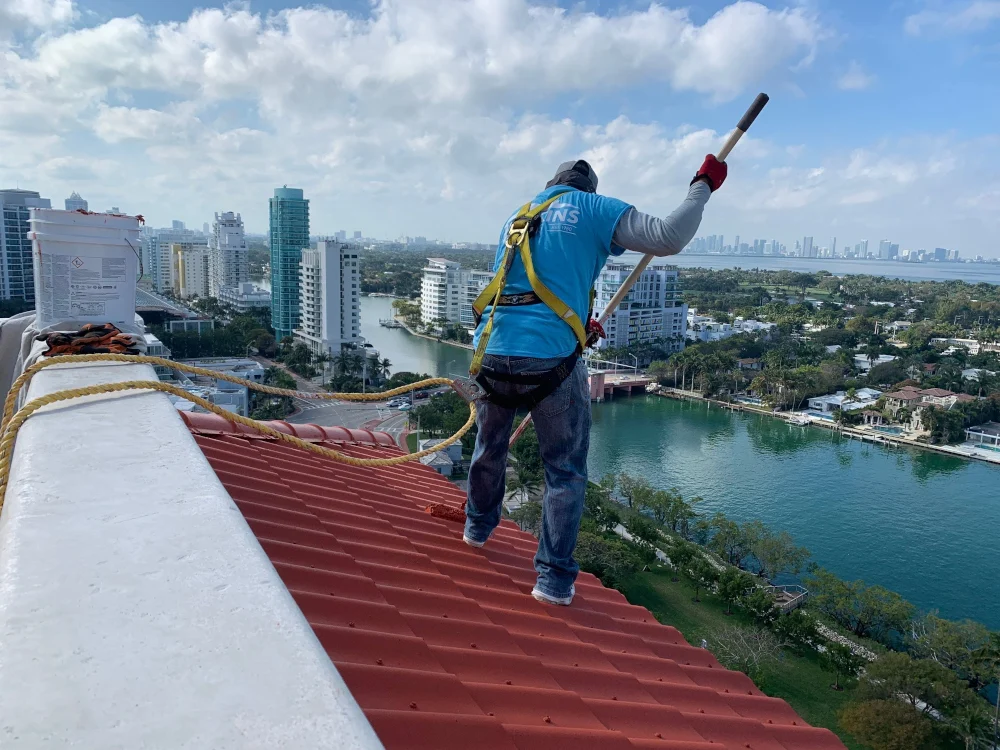
  • Confirm the contractor’s current Florida roofing license.
  • Request proof of insurance appropriate to the project.

  • Ask how occupied areas, tenants and rooftop access will be managed.

  • Confirm who will obtain permits and coordinate required inspections.

  • Require a written scope that identifies exclusions and allowances.

  • Keep product approvals, photographs, warranties and close-out records.

Commercial Roofing in Miami

Perkins Roofing Corp. operates under Florida Certified Roofing Contractor licence CCC1331944 and has served South Florida since 1980.

Plan for Hurricane Season Before There Is a Leak

The worst time to discover a commercial roofing weakness is during a major storm. Property managers should clear drainage, close outstanding repair items, document existing conditions and confirm emergency contact procedures before hurricane season.

A pre-season inspection does not eliminate storm risk, but it gives the owner an opportunity to address visible defects and establish a documented baseline for post-storm review.

For privacy reasons YouTube needs your permission to be loaded.

Questions to Ask a Commercial Roofing Provider

  • How much experience do you have with buildings similar to ours?
  • Which roof systems do you regularly install and maintain?

  • What approved assembly is proposed for this building?

  • How will you handle permits, inspections and any engineering requirements?

  • How will tenants, access and daily operations be managed?
  • What is included in the workmanship and manufacturer warranties?

  • What maintenance will the repaired, restored or replaced roof require?

  • What documentation will we receive at project completion?

Why Miami Property Owners Choose Perkins Roofing

Perkins Roofing combines decades of South Florida experience with commercial inspection, maintenance, repair, restoration and replacement services. The team works with property owners, managers, condominium associations and other commercial decision-makers across Miami-Dade and the wider South Florida region.

To discuss a commercial property in Miami, request a roofing quote or use the online estimate calculator. Property managers can also review the Miami-Dade HVHZ compliance guide and commercial roof inspection checklist for more detailed planning information.

Frequently Asked Questions

Many Miami commercial properties benefit from at least two scheduled roof-condition reviews each year: one before hurricane season and another after the most active storm period. Additional inspections may be appropriate after severe weather, reported leaks or work by HVAC and other rooftop contractors.

No. Localized defects may be addressed with targeted repairs, while a suitable existing roof may qualify for a compatible restoration system. Replacement should be evaluated when damage or trapped moisture is widespread, repairs are repetitive, the deck is affected or the roof is near the end of its practical service life.

Perkins Roofing evaluates modified bitumen, fluid-applied restoration systems, metal roofing and other approved systems according to the property. TPO may be considered for selected projects. Perkins Roofing does not offer EPDM roofing.

No. A roof-condition inspection assesses the roofing system and visible defects. A wind mitigation inspection is an insurance-related inspection completed on a prescribed form by an appropriately qualified inspector. Perkins Roofing may arrange a qualified third party when that service is required.

The proposal should clearly describe the existing conditions, recommended scope, proposed roof assembly, applicable product approval, permitting responsibility, exclusions, warranties and how access, safety, drainage and occupied areas will be managed.
Go to Top